KSeF vs SDI vs XRechnung: How Europe's Three Major E-Invoice Systems Compare
Poland's KSeF, Italy's SDI, and Germany's XRechnung represent three distinct approaches to mandatory e-invoicing. This comparison breaks down the architecture, format, submission model, and compliance requirements of each.
The EU now has three live mandatory B2B e-invoicing systems, each with a fundamentally different architecture. If you operate across multiple EU countries, understanding these differences is essential — not just for compliance, but for choosing the right software and intermediary.
Overview
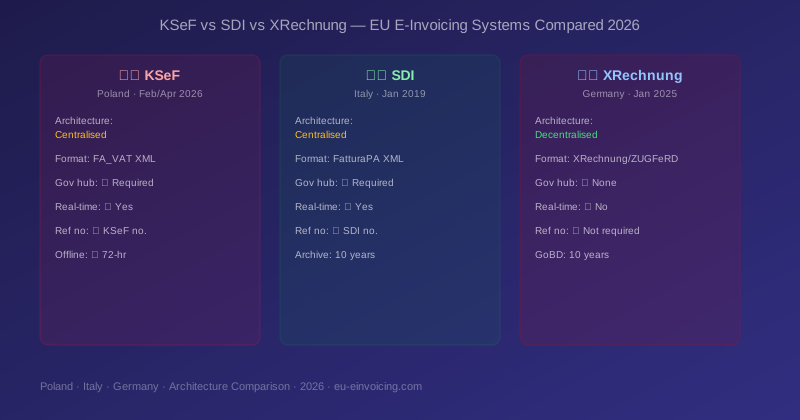
| Feature | KSeF (Poland) | SDI (Italy) | XRechnung/ZUGFeRD (Germany) |
| --------- | :------------: | :-----------: | :---------------------------: |
| Launch | Feb/Apr 2026 | Jan 2019 | Jan 2025 (receive) |
| Architecture | Centralised clearing house | Centralised clearing house | Decentralised (no hub) |
| Format | FA_VAT XML (own schema) | FatturaPA XML (own schema) | XRechnung (UBL/CII) or ZUGFeRD |
| Government hub | ✅ Required | ✅ Required | ❌ Not required |
| Real-time validation | ✅ Yes | ✅ Yes | ❌ No (sender validates) |
| Reference number required | ✅ KSeF number | ✅ SDI number | ❌ No |
| Offline mode | ✅ 72-hr window | ❌ N/A | ✅ N/A |
| Archive period | 10 years | 10 years | 10 years (GoBD) |
| Peppol compatible | ✅ Alongside | ✅ Alongside | ✅ Primary B2G channel |
The Centralised Model: KSeF and SDI
Both KSeF and SDI act as clearing houses — every invoice must pass through the government platform before it is legally valid:
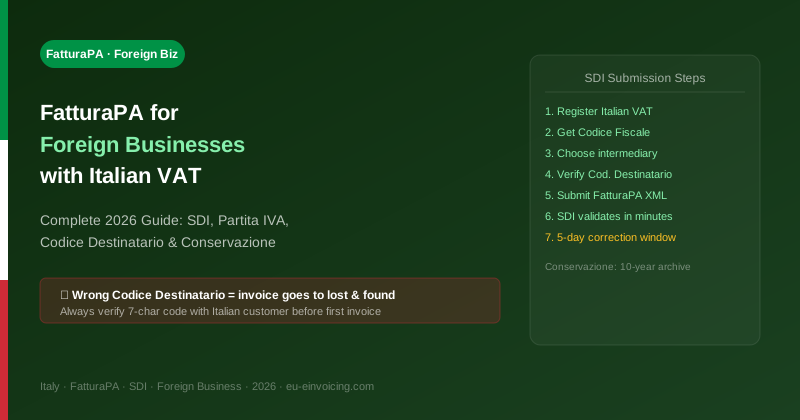
SDI (Italy, since 2019):
- Accepts FatturaPA XML
- Validates schema and business rules in near-real-time
- Assigns a unique SDI progressive number
- Routes to recipient (via Codice Destinatario or PEC)
- 5-day correction window after rejection
- Handles 1.2 billion invoices/year
KSeF (Poland, since 2026):
- Accepts FA_VAT XML
- Validates and assigns a KSeF reference number
- Buyer retrieves invoices from KSeF portal using the reference number
- Token-based authentication for API access
- 72-hour offline mode available
- Processes domestic Polish B2B only
The Decentralised Model: Germany
Germany chose a fundamentally different approach — no government hub:
- Sender generates a structured XML invoice (XRechnung or ZUGFeRD)
- Invoice sent directly to recipient (email, Peppol, or API)
- No government platform involved in the transmission
- Compliance is about the format and archiving, not a government reference number
- Validation is the sender's responsibility (using KoSIT validator)
- Peppol is used for B2G routing, but optional for B2B
Which Approach Is Coming to France?
France is implementing a hybrid — closer to Italy's SDI model but with private certified platforms (PDPs) competing for the routing role. The government PPF acts as a fallback, but PDPs handle most commercial traffic.
Implications for Multi-Country Businesses
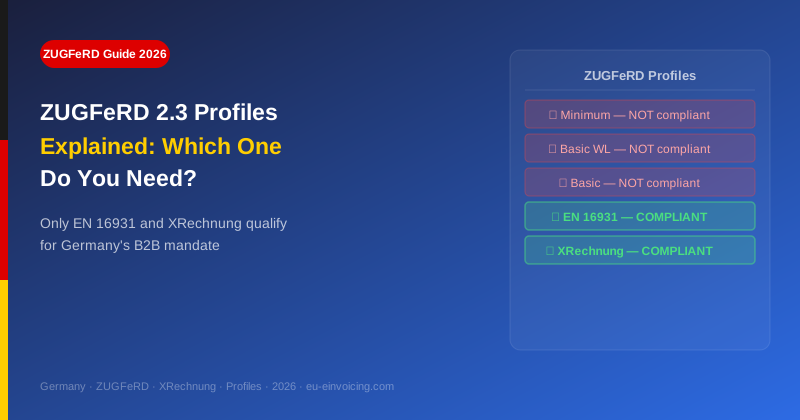
If you operate in all three countries, you need: 1. For Germany: Software that generates XRechnung or ZUGFeRD EN 16931 profile 2. For Italy: An SDI-certified intermediary or software with SDI submission built in 3. For Poland: KSeF API integration or a Polish certified intermediary 4. Cross-border: A Peppol access point connects all three for EU cross-border exchange
No single software solution has native, fully-certified support for all three systems as of May 2026 — most large enterprises use either SAP/Oracle with country localisation modules, or a specialised e-invoicing middleware layer.