"Handle It": Being the Person Your Boss Forwards EU E-Invoicing Emails To
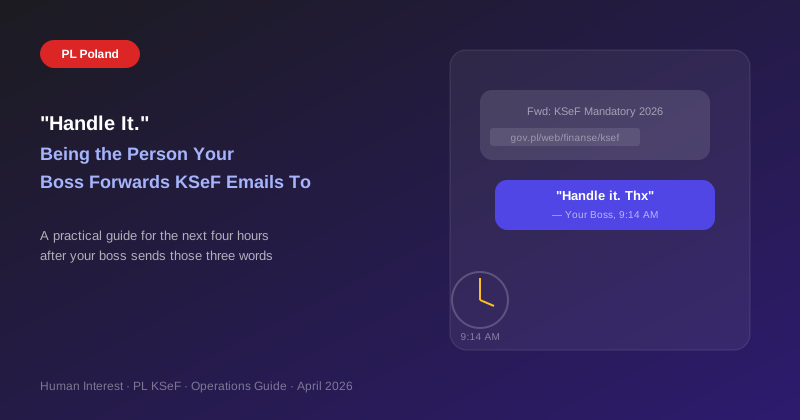
You are an operations manager. It is 9:14 AM. Your boss has just forwarded you a government announcement about Poland's KSeF mandate with the message 'Handle it.' This is a guide for that exact moment.
The email arrives at 9:14 AM. It is from your boss. It contains a forwarded message from your Polish subsidiary's accountant, which itself contains a link to a Ministry of Finance press release, which has been translated from Polish by Google Translate with mixed results. Your boss has added three words: "Handle it. Thx"
This is a guide for the next four hours.
---
9:14 AM — Do Not Panic
The most important thing to know is that "handle it" almost certainly means "figure out what we need to do and tell me." It does not mean "build a KSeF integration from scratch by Friday." It means someone needs to own the topic and not let it fall through the cracks.
You are now that person. This is actually fine. E-invoicing mandates are bureaucratic and technical but they are not complicated once you know what you are looking at.
---
9:20 AM — Understand What KSeF Actually Is
Poland's KSeF (Krajowy System e-Faktur) is a government platform that sits between two Polish businesses and validates every invoice. Every domestic B2B invoice in Poland now has to pass through KSeF and receive a reference number. No reference number, no legal invoice.
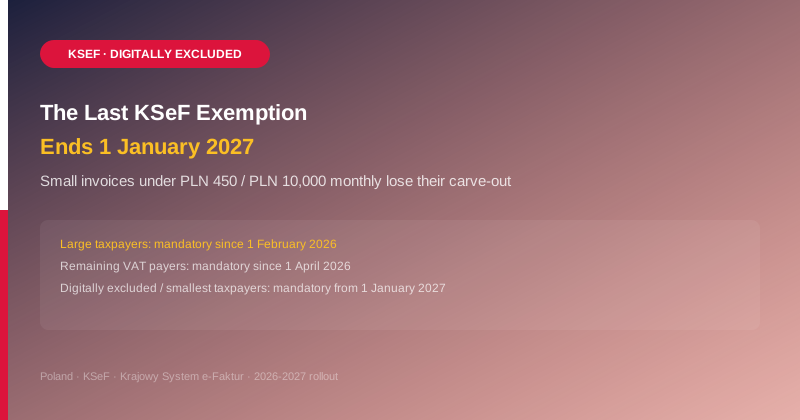
The mandate went live in February 2026 for large taxpayers and April 2026 for everyone else.
The key questions for your situation: 1. Does your company issue invoices to Polish businesses? (Not just to Polish consumers — business customers) 2. Does your company have a Polish VAT number?
If yes to either: KSeF affects you.
---
9:35 AM — Call Your Polish Accountant
Your Polish subsidiary's accountant (the one who sent the original email) knows more about this than anyone else you can reach today. Call them. Do not rely on the forwarded email chain.
Ask three questions: 1. Are we already compliant, or do we need to do something? 2. Is our Polish accounting software already integrated with KSeF? 3. Is there a specific deadline or audit risk right now?
If the accountant says "it's handled," believe them, send your boss an update, and move on. A significant portion of "handle it" situations resolve this way.
---
10:00 AM — If You Need to Actually Handle It
If your Polish operations are not yet compliant, the path forward involves:
Software check first. KSeF compliance is a software problem, not a human problem. If your Polish entity uses any major Polish ERP or accounting platform — Comarch, INSERT nexo, Enova365, Sage Symfonia — it almost certainly has a KSeF module. Check whether it is activated.
The token problem. KSeF authentication uses cryptographic tokens tied to your NIP (Polish tax ID). If nobody has set these up, this is the actual technical hurdle. Your Polish IT team or accountant handles this. It is not something you do from headquarters.
Multinationals beware. If your Polish subsidiary runs invoicing through a non-Polish ERP at headquarters level (SAP, Oracle, Dynamics with no Polish localisation), you may need a middleware solution. This takes longer and costs more. Budget accordingly.
---
11:30 AM — Write the Update to Your Boss
Keep it to three sentences:
"KSeF is Poland's mandatory e-invoicing system that went live in [February/April] 2026. I spoke with [Name] at our Warsaw office — [we are compliant / we need to activate the KSeF module in our accounting software by X date]. No legal risk at the moment; I will follow up by [date] with confirmation."
That is a complete update. Your boss will be satisfied. You have handled it.
---
The Bigger Picture
If you are doing this job for more than one country — say, someone also forwarded you something about Germany's 2027 mandate or France's September 2026 rollout — the pattern is identical. Each country has a technical format, a compliance deadline, and a software solution. The operations manager's job is to connect the compliance deadline to the correct software vendor and confirm it is activated before the deadline.
Nobody is expecting you to read XML schemas. That is what accountants and ERP vendors are for.
You have handled it.