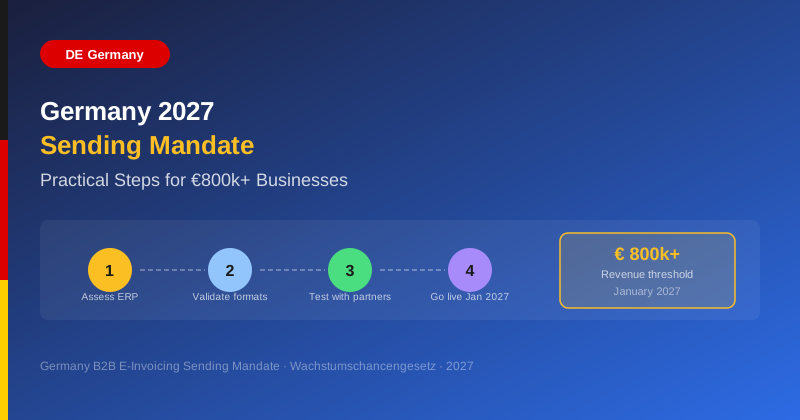
Germany 2027 Sending Mandate: Practical Steps for Businesses Above €800k Revenue
German businesses with annual revenue over €800,000 must send structured e-invoices from 1 January 2027. Here is the practical checklist to get ready — software, testing, and supplier communication.
The 1 January 2027 deadline is less than a year away. If your German business generated more than €800,000 in annual revenue in the most recent fiscal year, you must start sending XRechnung or ZUGFeRD e-invoices to all domestic B2B customers by that date.
Here is a practical, step-by-step guide based on what early adopters have already done.
Step 1: Confirm Your Revenue Threshold
The €800,000 threshold applies to total annual revenue (Gesamtumsatz), not just B2B revenue. Check your 2025 tax assessment. If you were above the threshold, the 2027 mandate applies to you.
Note: The threshold drops to zero in 2028, when all German businesses must send structured e-invoices regardless of size.
Step 2: Audit Your Current Invoicing Process
Before selecting software, map your current process:
- How many invoices do you send per month?
- Do you invoice via ERP, standalone accounting software, or manually?
- Do any customers have specific format requirements (e.g., Leitweg-ID for government clients)?
- Do you invoice cross-border? (XRechnung only applies to domestic German B2B)
Step 3: Choose Your Format — XRechnung or ZUGFeRD?
Both qualify. The practical difference:
| XRechnung | ZUGFeRD | |
| Human-readable | ❌ XML only | ✅ PDF + embedded XML |
| B2G invoices | ✅ Required | ✅ Allowed |
| B2B invoices | ✅ | ✅ |
| Customer preference | Tech-heavy customers | Better for most SMEs |
For most SMEs, ZUGFeRD (EN 16931 profile) is the easier path. It looks like a normal PDF to the recipient but contains the structured XML your obligation requires.
Step 4: Validate Before You Send
Never assume your software's output is correct. Use the [KoSIT online validator](https://www.portalu.de/de_DE/katalog/kv_xrechnung;jsessionid=) to validate a sample invoice before going live. Common errors:
- Wrong ZUGFeRD profile (use EN 16931, not Minimum or Basic)
- Missing buyer reference (BT-10)
- Invalid VAT category codes
Step 5: Communicate with Your Customers
Your B2B customers should already be able to receive structured e-invoices (they have been required to since January 2025). But it is still good practice to:
- Notify them of your switchover date
- Confirm their preferred receiving channel (email, Peppol, API)
- Ask for their Leitweg-ID if they are a public authority
Step 6: Test End-to-End
Send one or two test invoices to a willing customer before switching your entire workflow. Check:
- Does the recipient's accounting software accept and parse the invoice correctly?
- Are the amounts, VAT, and payment terms correctly extracted?
- Does the invoice pass the KoSIT validator?
Software Recommendations for German SMEs
- DATEV — Dominant in Germany, full XRechnung/ZUGFeRD support
- sevDesk — Cloud-native, easy ZUGFeRD, good for smaller businesses
- Lexware — Strong for established SMEs, GoBD-certified archiving
- easybill — Best API for tech-forward businesses, Peppol access point built in