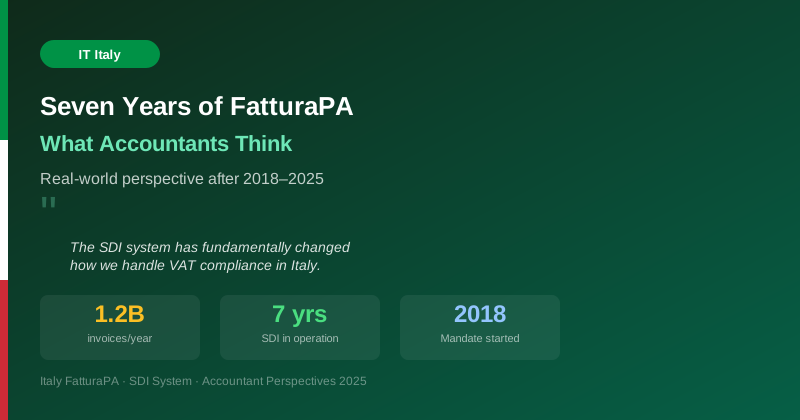
Seven Years of FatturaPA: What Italian Accountants Actually Think
Italy's e-invoicing mandate launched in January 2019. Seven years on, we asked Italian accountants and small business owners what the reality looks like — the good, the frustrating, and what they wish they'd known.
Italy introduced mandatory B2B e-invoicing in January 2019 — making it the first EU country to do so at scale. Seven years later, the SDI system is processing over 1.2 billion invoices a year, and the dust has well and truly settled.
But what is the day-to-day reality for the people who actually use it?
I spent time speaking with accountants (commercialisti) and small business owners across northern and central Italy — the people who handle this every day. Here is what they told me, in their own words.
---
"It Was Terrifying at First. Now I Can't Imagine Going Back."
Giulia, 52, commercialista in Verona
"January 2019 was chaos. I had clients calling me every day — 'the SDI rejected my invoice', 'what is a codice destinatario', 'why did it come back with a PA04 error'. My office added three extra staff just to handle the transition questions.
But by March, most clients had settled into a routine. By June, it was just... normal. The SDI rejects are immediate now — you know within hours if something is wrong, not three weeks later when the customer calls to say they never received it.
What I didn't expect: my clients actually get paid faster. The invoice arrives instantly, it's validated, it's in the buyer's system automatically. There's no 'I never received it' any more."
---
"The Conservazione Sostitutiva Cost Was a Surprise"
Marco, 38, runs a small manufacturing company in Brescia
"Nobody told me that I also needed to pay separately for conservazione sostitutiva — the legally required 10-year digital archive. My accountant uses Aruba, which includes it, but when I tried to manage invoices myself through the Agenzia delle Entrate portal, I realised the archive wasn't automatic.
Small thing, but it cost me €80 the first year with a third-party provider until I switched to software that included it. Read the small print."
---
"The Agenzia delle Entrate Portal is Fine for Very Small Volumes"
Francesca, 45, freelance consultant in Milan
"I do maybe 15–20 invoices a year. I use the free portal on the Agenzia delle Entrate website — the one built into the Fatture e Corrispettivi section. It takes about 3 minutes per invoice once you know what you're doing. For my volume, it's completely adequate.
The SDI validation is instant. I've only had one rejection in seven years — I had the wrong codice fiscale for a new client. Corrected it in ten minutes."
---
"Cross-Border is Still Complicated"
Roberto, 56, exports manager at a Veneto textile company
"For Italian domestic invoices, everything works. But when we invoice our German customers — who now need XRechnung or ZUGFeRD, not FatturaPA — it's a whole separate system. We had to add a Peppol access point just for the German invoices.
The EU says ViDA will unify everything by 2030. I'll believe it when I see it. For now, if you invoice across borders regularly, you need separate processes for each country."
---
The Numbers Don't Lie
The data backs up what these businesses experience:
- Italian VAT gap (uncollected VAT) has shrunk by €4 billion since 2019
- Average payment cycle for Italian B2B invoices fell from 38 days to 21 days after SDI adoption
- SDI now processes 1.2 billion invoices per year with a 99.7% uptime record
For other EU countries watching Italy's model: the transition is hard, the first few months are stressful, and then it becomes invisible infrastructure. That is the lesson.
---
Practical Tips from Italian Users
- Don't use the Agenzia delle Entrate portal for more than 50 invoices/year — it works, but software saves hours
- Check your *codice destinatario* before sending — a wrong 7-character code means an immediate rejection
- Set up SDI notifications — your intermediary can email or webhook you on acceptance/rejection
- Confirm conservazione sostitutiva is included in your software contract, not charged separately
- For cross-border invoicing — get a Peppol access point in addition to your SDI intermediary