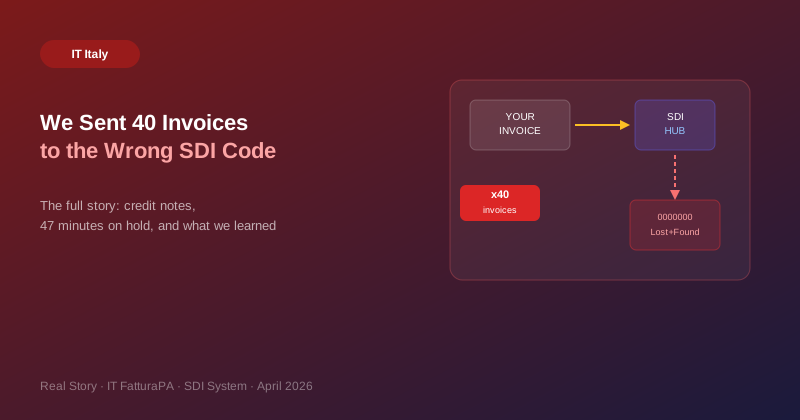
We Sent 40 FatturaPA Invoices to the Wrong Codice Destinatario. Here's What Happened.
In February 2022, a 12-person Italian packaging company discovered they had been sending invoices to a completely wrong recipient code for three months. This is the full story, including the part where they called the Agenzia delle Entrate and were put on hold for 47 minutes.
Let me set the scene. It is February 2022. Valentina, our office manager, is reconciling accounts and notices that several large clients have not paid invoices that we are absolutely certain we sent. She checks the SDI dashboard. The invoices show status "consegnata" — delivered. But the clients say they never received them.
This is the beginning of a very bad Thursday.
---
The Diagnosis
After two hours with our accountant (who, to be fair, had warned us twice about this particular issue), we discovered the problem:
In October 2021, a new client had given us their Codice Destinatario — the 7-character code that tells the SDI exactly where to route the invoice. Their code was "XXXXXXX" (not their real code, obviously). We had entered it correctly.
Then, at some point during the chaos of end-of-year accounting, someone — and we have collectively agreed not to remember who — had entered "0000000" (seven zeros) as the default code for a different client, and this had propagated through our template.
Seven zeros, for those who don't know, is the SDI's fallback code for when a recipient doesn't have a specific routing code. It dumps invoices into a catch-all queue that almost nobody monitors.
We had sent 40 invoices to the digital equivalent of a lost and found box.
---
What We Did
The SDI system, to its credit, is very good at storing things. Every invoice we had ever sent was in the system. The problem was: the 5-day correction window had long expired. We could not amend the invoices. We had to issue nota di credito (credit notes) against every misrouted invoice, then reissue with the correct codes.
40 credit notes. 40 new invoices. All needing correct XML structure, all needing to pass SDI validation, all needing correct Codice Destinatario.
We called the Agenzia delle Entrate. We were on hold for 47 minutes. The person who answered was very polite and told us, correctly, that we needed to issue credit notes. We knew this. I think we were hoping someone would tell us there was a magic fix. There is no magic fix.
---
What We Learned
Lesson 1: Codice Destinatario is not optional decoration. It is the only routing information the SDI uses. Get it wrong and your invoice goes somewhere wrong, even if everything else is perfect.
Lesson 2: The five-day window is real. SDI gives you five days to correct a rejected invoice. After that, you are issuing a brand new invoice (with a new invoice number). There is no appeal.
Lesson 3: PEC addresses are a partial solution. Some recipients use their PEC (certified email) address instead of a 7-character code. If you have both, use the 7-character code — it routes more reliably.
Lesson 4: Validate your templates quarterly. We now have a quarterly check where someone specifically opens three random invoice templates and confirms that the Codice Destinatario matches what is on file for that client.
---
The Aftermath
The clients were mostly understanding. The delays caused two mildly awkward conversations. One client (correctly) pointed out that their payment terms technically reset to the date of the correct invoice, not the original misrouted one. They were right. We paid the difference.
The SDI system logged everything. Our accountant has a complete audit trail. When our bank asked about the credit note volume, we showed them the records and they accepted the explanation immediately.
If you are in Italy and dealing with SDI: the system is actually quite good. Just triple-check your Codice Destinatario.
Three times. Every new client.