How Italy, Poland and France Are Already Running the Reporting Model ViDA Will Require EU-Wide
The EU will not mandate cross-border digital reporting until 1 July 2030 — but Italy, Poland, and (from 2026) France already operate domestic systems that work the same way. Here is what their head start means for the rest of the EU.
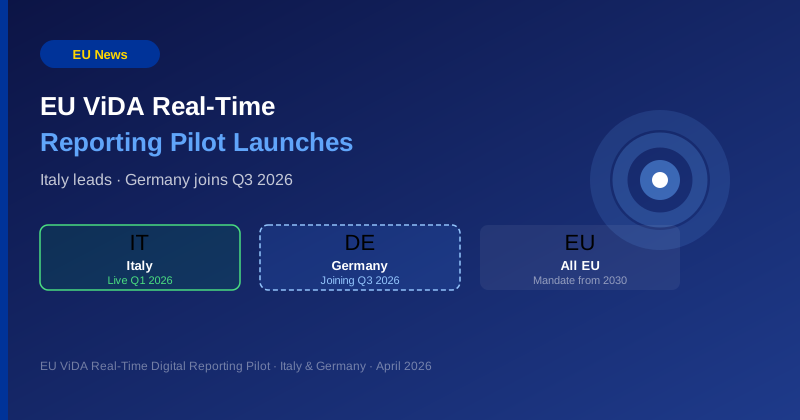
The VAT in the Digital Age (ViDA) package does not make cross-border Digital Reporting Requirements (DRR) mandatory until 1 July 2030. But several member states already run domestic continuous transaction control (CTC) systems that work on the same principle ViDA will require EU-wide: structured, government-visible invoice data instead of paper or PDF.
The Three Head Starts
Italy — SDI (since 2019)
Every domestic B2B invoice already passes through the Sistema di Interscambio (SDI) in FatturaPA format before reaching the buyer. The Agenzia delle Entrate has real-time visibility into practically all domestic VAT transactions.
Poland — KSeF (since February 2026)
Poland's Krajowy System e-Faktur now routes B2B invoices through a government platform in FA(3) XML, with a KSeF reference number required for VAT purposes.
France — Chorus Pro / PDP network (rolling out from September 2026)
France's model is closer to ViDA's own design: invoices flow through accredited private "PDP" platforms rather than a single government portal, with transaction data still reported to the tax authority (DGFiP).
Why This Matters for ViDA's 2030 Deadline
The European Commission's own 2026 ViDA work programme builds on these existing national systems rather than replacing them. Under the rules adopted alongside ViDA, member states with a domestic real-time reporting system already in place before 1 January 2024 — Italy, France, and Poland among them — have until 1 January 2035 to align that system with the EU model, two years later than the general 1 July 2030 cross-border deadline.
What Businesses Outside These Countries Should Take Away
If your business already issues structured, EN 16931-compliant e-invoices — XRechnung, FatturaPA, Factur-X, KSeF's FA(3), or Peppol BIS — you are already producing the data ViDA's cross-border DRR will require. The remaining piece, due by 2030, is a reporting channel from your invoicing system to your national tax authority, which most established e-invoicing vendors are already building toward.
Source
European Commission, Taxation and Customs Union — VAT in the Digital Age and 2026 work programme.