France's E-Invoicing Mandate Officially Goes Live
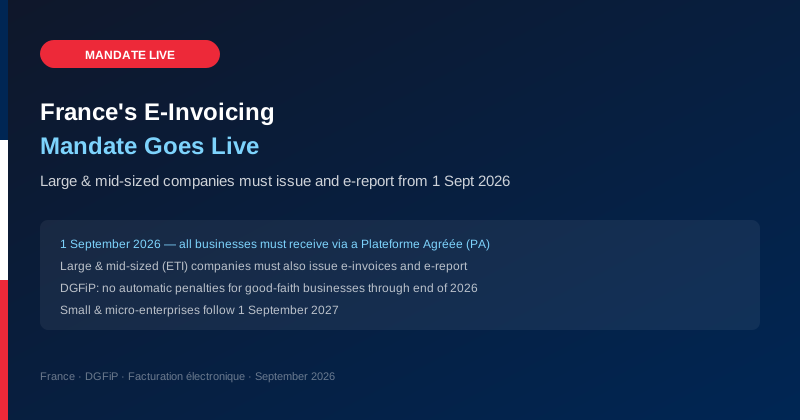
France's B2B e-invoicing and e-reporting reform took effect on 1 September 2026: every VAT-registered business must now be able to receive structured invoices, and large and mid-sized companies must issue them and e-report transaction data. The DGFiP has confirmed no automatic penalties for good-faith businesses through the end of 2026.
After years of delays, pilots, and rulebook changes, France's B2B e-invoicing reform is no longer a future deadline — it took effect on 1 September 2026.
What Changed on Day One
From 1 September 2026:
- Every VAT-registered business established in France must be able to receive structured e-invoices through an accredited platform, a Plateforme Agréée (PA) — the new name for what was previously called a PDP (Plateforme de Dématérialisation Partenaire).
- Large enterprises and mid-sized companies (ETI) must additionally issue structured e-invoices for domestic B2B transactions and e-report transaction and payment data to the tax authority.
- Small businesses and micro-enterprises are not yet required to issue e-invoices — that obligation follows on 1 September 2027, though they too must be able to receive from day one.
Accepted formats remain Factur-X (hybrid PDF/XML), pure UBL, and CII, all built on the EN 16931 European semantic standard, exchanged through PAs connected to the Public Invoicing Portal (Portail Public de Facturation, PPF) directory service.
No Automatic Penalties Through 2026
The Direction Générale des Finances Publiques (DGFiP) has confirmed — for the first time explicitly — that it will not automatically sanction businesses that are acting in good faith but hit technical difficulties during the startup period. This tolerance covers 2026 only; it softens enforcement, not the legal obligation itself, which is already in force. Under the standard penalty framework, non-compliance can otherwise expose businesses to fines tied to VAT amounts involved, so the tolerance period is a grace window for genuine effort, not a reason to delay integration.
Platforms operating as PAs also face their own compliance clock: cybersecurity status reporting and incident disclosure requirements, plus penetration testing, are being phased in through autumn 2026, with suspension a possibility for PAs that fall short.
Why This Matters Beyond France
France's rollout is one of the largest and most closely watched e-invoicing mandates in the EU, and several compliance vendors reported bringing multinational clients live ahead of the deadline given the scale of the transition. For any business trading with French counterparties — even without a French establishment — this is the point at which "get ready for September" becomes "confirm your invoices are actually landing," since receiving capability is now a live legal requirement rather than a future one.
What Businesses Should Do Now
- Confirm your PA integration is actually working end-to-end, not just technically certified — test a real invoice round-trip if you haven't already.
- If you're a large or mid-sized company, verify your e-reporting feed is transmitting transaction data, not just that invoices are being issued.
- Don't treat the "no penalties in 2026" tolerance as license to deprioritize compliance — it protects good-faith effort, not inaction, and the obligation itself is already live.
Source
Sovos, France's E-Invoicing Mandate Goes Live — What Businesses Need to Know.