Poland: KSeF Invoice Number Becomes Mandatory in Split-Payment Transfers From 2027
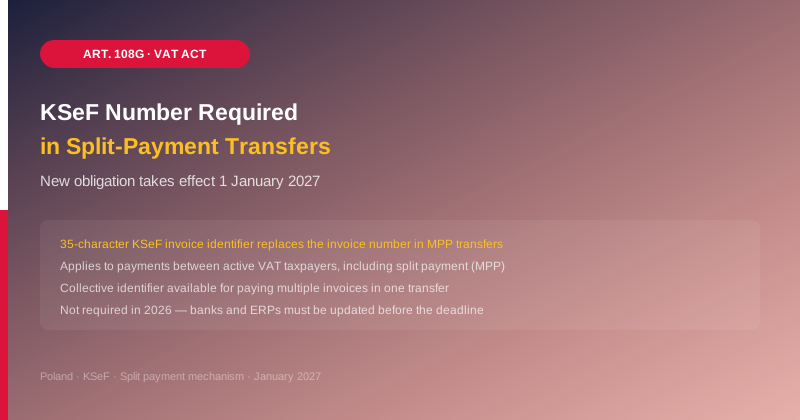
A new obligation under Article 108g of Poland's VAT Act will require the 35-character KSeF invoice identifier to appear in split-payment (MPP) bank transfer messages from 1 January 2027, replacing the plain invoice number businesses use today.
Poland's KSeF rollout isn't just about issuing and receiving invoices — it's starting to reshape how invoices get paid, too. A new legal requirement, tucked into Article 108g of the Ustawa o VAT (VAT Act), will change what businesses must write in the payment reference field when settling invoices under the split payment mechanism (mechanizm podzielonej płatności, MPP).
What Changes on 1 January 2027
From 1 January 2027, when a business settles an invoice using the split payment mechanism, the bank transfer message must include the KSeF number — a unique 35-character identifier automatically assigned to every structured invoice issued through the Krajowy System e-Faktur — instead of, or alongside, the invoice number currently used. The obligation applies specifically to payments made between active VAT taxpayers, matching the scope of the split payment mechanism itself.
For businesses that settle multiple invoices with a single transfer, the rules provide for a collective identifier, generated to cover the batch, rather than requiring every individual KSeF number to be listed separately.
Not a 2026 Requirement
As of today, the KSeF number is not a mandatory element of a split-payment transfer message — that obligation only begins with the 1 January 2027 commencement of Article 108g. Businesses currently using KSeF for invoicing under the mandate phases that started in February and April 2026 do not yet need to change their payment references, but banks, accounting software, and ERP systems serving Polish businesses have roughly a year to update payment templates and transfer forms before the deadline becomes binding.
Why This Is a Bigger Deal Than It Sounds
Split payment already routes VAT amounts directly into a supplier's dedicated VAT account rather than their main account, as an anti-fraud measure. Tying the payment message to the specific KSeF-assigned invoice number closes a gap: it lets banks and tax authorities automatically match a specific structured invoice to its corresponding payment, rather than relying on free-text invoice numbers that vary in format between suppliers and are easy to mistype or omit. This is a continuation of Poland's broader pattern — using KSeF not just for invoice exchange, but as a backbone for automated VAT reconciliation.
What Businesses in Poland Should Do Now
- Don't wait until late 2026 to check your accounting/ERP vendor's roadmap for KSeF-number payment references — this touches payment workflows and bank integrations, not just invoicing modules.
- If you frequently pay multiple invoices in a single transfer, ask your software provider how it plans to generate the collective identifier required for batch payments.
- Treat this as a 2027 deadline, not a 2026 one — some vendor blogs have conflated this with earlier technical pilots; the binding legal obligation under Article 108g starts 1 January 2027.
Source
Polish Ministry of Finance VAT Act amendment (Article 108g, Ustawa z dnia 11 marca 2004 r. o podatku od towarów i usług); analysis via DrukarkaKSeF.pl — Numer KSeF w przelewie: nowy obowiązek od 2027 roku.