KSeF Ruling Confirms: Once an Invoice Has a KSeF Number, It Cannot Be Deleted
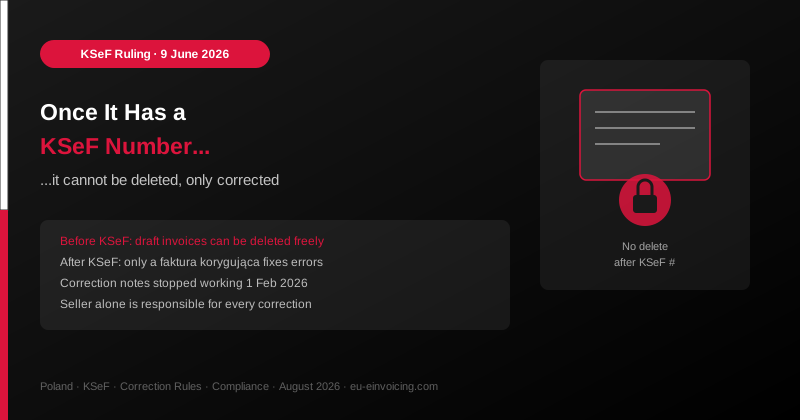
A tax ruling issued 9 June 2026 by Poland's Director of National Tax Information draws a firm line: invoices can only be deleted before they reach KSeF and receive a reference number. After that, the only fix is a formal corrective invoice (faktura korygująca) — also issued through KSeF.
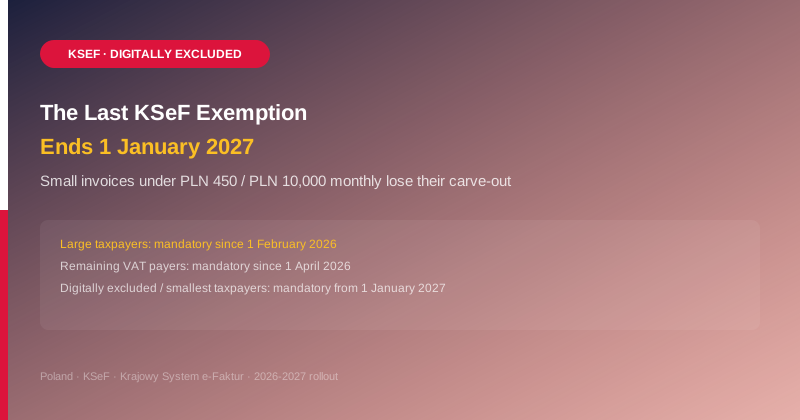
Poland's Krajowy System e-Faktur (KSeF) became mandatory for the largest taxpayers (turnover above 200 million PLN) on 1 February 2026, with all remaining VAT-registered businesses following on 1 April 2026. Six months in, a tax ruling is clarifying one of the system's most consequential technical boundaries: what happens when an invoice is wrong.
The Ruling
On 9 June 2026, Poland's Director of National Tax Information (Dyrektor Krajowej Informacji Skarbowej) issued a ruling drawing a clear dividing line:
- Before KSeF submission: an invoice that exists only as a draft or internal XML file — one that has not yet been sent to KSeF and assigned a reference number — can be deleted outright. It never entered legal circulation, so nothing needs to be corrected.
- After KSeF assignment: once KSeF accepts the file and issues a KSeF reference number, the invoice is irreversibly in legal circulation. There is no "withdraw" or "delete" function. The only way to fix an error — even a minor one, like a typo in the buyer's name or address — is to issue a formal corrective invoice (faktura korygująca), itself submitted through KSeF.
Why This Matters More Since February 2026
This boundary has been part of KSeF's technical design since the system launched, but it took on new weight after a separate change on 1 February 2026: correction notes (noty korygujące) — previously a lighter-weight tool buyers could use to flag minor seller errors — stopped functioning as a legal correction mechanism. The obligation to correct an invoice now rests solely with the seller, for every category of error, however small. A buyer who spots a mistake can no longer fix it themselves; they must report it back to the seller, who then issues the corrective invoice.
Practical Impact for Businesses
- Pre-submission review is now the only real safety net. Once a KSeF number is assigned, there is no cheap way to walk back an error — every fix is a corrective invoice, with its own bookkeeping and VAT-period implications.
- Build a validation step before transmission. Most Polish accounting platforms with KSeF integration (Comarch ERP Optima, InsERT nexo, enova365, wFirma) support a draft/preview stage — use it.
- Train invoicing staff on the new correction-only workflow. The days of a quick correction note for a typo are over; every error, however trivial, now needs a corrective invoice cycle.
Source
PIT.pl, Faktura z błędem przed wysyłką do KSeF – usunąć czy korygować? Fiskus wyznaczył granicę.