Romania Rolls Back E-Factura Mandate for Copyright Individuals, Farmers, and Foreign Cultural Institutes
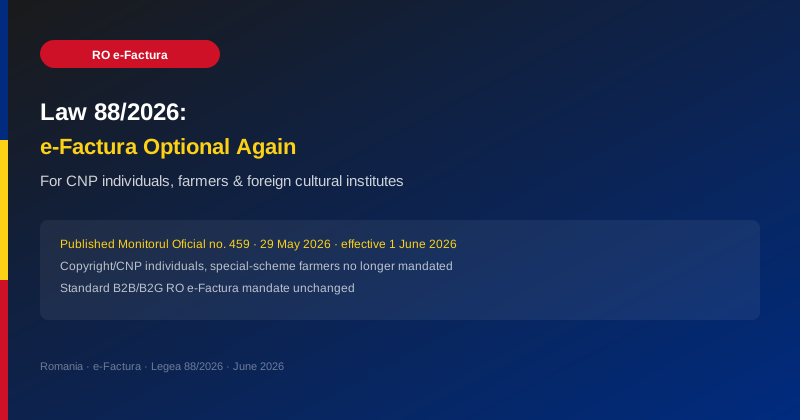
Law No. 88/2026, published in Romania's Monitorul Oficial on 29 May 2026 and effective 1 June 2026, reverses an earlier extension of the RO e-Factura mandate — making the system optional again for individuals invoicing under their personal identification number (CNP), farmers under the special VAT scheme, and foreign cultural institutes.
Romania has narrowed the scope of its RO e-Factura mandate for a specific group of taxpayers, reversing a rule that had pulled them into the mandatory system only months earlier. Legea nr. 88/2026 was published in the Monitorul Oficial (no. 459) on 29 May 2026 and took effect 1 June 2026.
Who's Affected
The law amends Article 1010 of OUG (Government Emergency Ordinance) no. 120/2021, the underlying legislation governing RO e-Factura. It removes the mandatory e-invoicing obligation for:
- Individuals invoicing through their personal identification number (CNP) rather than a business tax ID — this primarily covers writers, journalists, photographers, actors, and other artists and content creators earning income from copyright and intellectual property
- Individual farmers operating under Romania's special VAT scheme for agricultural producers
- Foreign cultural institutes and centers operating in Romania under intergovernmental agreements
For these groups, use of RO e-Factura becomes optional rather than mandatory. Taxpayers who no longer need or want to use the system can request removal from the RO e-Factura registers, while retaining the option to keep using it voluntarily.
Why This Is a Reversal, Not a New Rule
Earlier changes to Romania's e-invoicing framework in early 2026 had extended mandatory RO e-Factura obligations to these same groups. Law 88/2026 walks that extension back for CNP-based individuals, special-scheme farmers, and foreign cultural institutes specifically — while leaving the core B2B and B2G RO e-Factura mandate for standard VAT-registered businesses unchanged. The law also clarifies related B2C transaction rules: where a customer doesn't provide a tax identification code (a natural person using only a CNP, for instance), suppliers must use a standardized 13-zero placeholder code in the beneficiary identification field.
What This Means in Practice
If you're a freelance writer, journalist, photographer, or similar creative professional invoicing under your CNP, or a farmer under Romania's special agricultural VAT scheme, you are no longer required to issue invoices through RO e-Factura as of 1 June 2026 — though you may continue using it if you already have a workflow built around it. Standard VAT-registered businesses and companies remain fully subject to the existing RO e-Factura B2B/B2G mandate; this rollback does not change their obligations.
Source
Portal Legislativ (Romanian Ministry of Justice), LEGE 88 29/05/2026, published in Monitorul Oficial no. 459 of 29 May 2026.