Hungary Extends Mandatory E-Invoicing to Water Utilities, Following Energy Sector's Lead
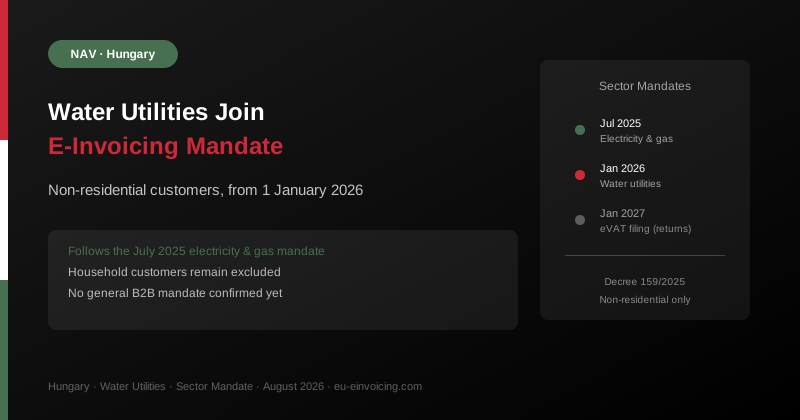
From 1 January 2026, Hungarian water utility providers must issue electronic invoices to non-residential customers under Government Decree 159/2025 — extending the sectoral e-invoicing mandate that already covered electricity and natural gas suppliers from July 2025.
Hungary is building its domestic e-invoicing requirements sector by sector, ahead of any economy-wide B2B mandate. The latest addition: water utilities.
What Changed on 1 January 2026
Under Government Decree 159/2025, Hungarian water utility service providers are now required to issue electronic invoices to non-residential (business) customers for water supply services. Residential household customers are excluded from the requirement. The legal framework sits within Hungary's existing VAT invoicing rules — Act CXXVII of 2007 on Value Added Tax and its implementing decree, Government Decree 23/2014 — the same statutory basis used for the earlier energy-sector mandate.
Following the Energy Sector's Pattern
This is not Hungary's first sectoral e-invoicing mandate. From 1 July 2025, electricity and natural gas traders, distributors, and transmission system operators were already required to issue B2B invoices exclusively in electronic form. The water utility mandate extends the same approach — a sector-specific carve-out rather than a general B2B requirement — to a second category of utility supply.
Unlike Germany's XRechnung/ZUGFeRD mandate or Poland's KSeF, Hungary's utility e-invoicing rules do not currently prescribe a specific structured format or transmission channel — the requirement is that the invoice be issued electronically, within the existing framework of Hungary's real-time invoice reporting (RTIR) regime, which continues to apply to these transactions as it does economy-wide.
Where This Fits in Hungary's Broader E-Invoicing Roadmap
Hungary does not yet have a confirmed general B2B e-invoicing mandate. NAV and the Ministry of National Economy ran a public consultation on a ViDA-aligned, EN 16931-based e-invoicing and e-reporting framework that closed in January 2026, proposing a five-corner model with optional Peppol connectivity — but no enacted law or confirmed go-live date has followed as of this writing. Separately, NAV's new eVAT digital VAT-return system (a filing mechanism, distinct from invoice issuance) becomes mandatory from 1 January 2027.
The water and energy sector mandates should be read as narrow, utility-specific rules — not signals of an imminent general mandate. Businesses outside the electricity, gas, and water utility sectors have no current e-invoicing issuance obligation beyond standard RTIR reporting of invoice data.
What Affected Businesses Should Do
- Water utility providers invoicing non-residential customers should confirm their billing systems issue electronic invoices, not just electronic reporting of invoice data — the two are distinct obligations under Hungarian law.
- Business customers of water utilities should expect to start receiving electronic invoices rather than paper ones, if they have not already.
- Everyone else in Hungary should treat this as a sector-specific update, not a preview of a general deadline — no such deadline has been enacted yet.
Source
VATupdate, Hungary is making e-invoicing mandatory for water supplies; Orbitax, Hungary is making e-invoicing mandatory for water supplies.