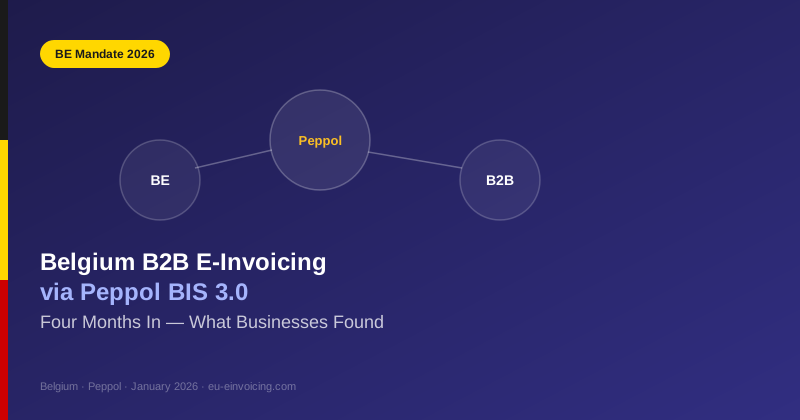
Belgium B2B E-Invoicing via Peppol: Four Months In — What Businesses Found
Belgium's mandatory B2B e-invoicing via Peppol BIS 3.0 went live on 1 January 2026 for all VAT-registered businesses. Here is a candid first-quarter review: what worked, what did not, and what the rest of the EU can learn.
Belgium became the fourth EU member state — after Italy, Germany, and Poland — to mandate B2B e-invoicing when its Loi du 6 juillet 2023 entered into full force on 1 January 2026. The Belgian model is distinctive: it mandates Peppol BIS 3.0 as the only required format and uses Peppol's four-corner network rather than a government clearing house.
Four months after the go-live date, Belgian businesses and accountants have offered a frank assessment.
What the Belgian Mandate Requires
Every Belgian VAT-registered business — regardless of size — must, from 1 January 2026:
- Send structured e-invoices in Peppol BIS 3.0 (or the national Belgian version of the standard) for all domestic B2B transactions
- Receive structured e-invoices through a certified Peppol access point
- Register on the Belgian Peppol SMP directory with a valid Peppol ID
The authority responsible is SPF Finances / FOD Financiën — Belgium's federal tax authority.
The format requirements and legal basis are published on the Belgian tax authority website: eFactuur.be.
What Went Smoothly
Software providers were ready. Belgian accounting platforms — Exact Online, Billit, and BOB Software — had Peppol-ready modules available well before the January deadline. Accountancy firms reported that most of their SME clients were configured and live within the first two weeks of January.
The Peppol network already had critical mass. Because Belgium had a B2G Peppol mandate since 2020, the network infrastructure existed. Many Belgian businesses already had Peppol IDs for government invoicing — they simply needed to activate B2B functionality.
Penalty-free grace period. The Belgian tax authority confirmed a six-month administrative tolerance period through June 2026, during which businesses failing to comply would receive guidance rather than fines. This reduced first-month panic significantly.
What Was Harder Than Expected
Micro-businesses and self-employed. Sole traders and very small businesses (<5 employees) had the most difficulty. Many relied on paper or Word-based invoicing and had no accounting software at all. Belgium's free Peppol-via-Hermes.be portal addresses this, but uptake among micro-businesses was slower than anticipated.
Buyer-side readiness. Some Belgian businesses that sent Peppol invoices found their customers' Peppol IDs were not yet active in the directory, causing delivery failures. The delivery failure rate in January was reported at approximately 8% — much higher than anticipated. By March, this had fallen below 2%.
International suppliers. Foreign businesses invoicing Belgian VAT-registered customers must also comply — but many non-Belgian accounting software providers did not have Belgian Peppol support ready on day one. This led to friction for cross-border B2B supply chains.
The Belgian Peppol Architecture
Belgium's B2B Peppol implementation uses the standard four-corner model:
- Corner 1: The sender (you, or your accounting software)
- Corner 2: Your Peppol access point (provided by your software or a standalone provider)
- Corner 3: Your customer's Peppol access point
- Corner 4: Your customer
Every participant needs a Peppol ID (typically formatted as 0208:BEXXXXXXXXXX where the numeric portion is the Belgian company number).
Lessons for Other EU Countries
Belgium's experience reinforces several themes seen in Italy and Germany:
- The transition is harder for micro-businesses than for SMEs — targeted support programs matter
- Buyer-side SMP registration must be enforced — mandating sending without mandating reception creates delivery failures
- Grace periods reduce panic without undermining compliance — the six-month tolerance worked
- Peppol as the single format simplifies cross-border — Belgium's invoice can route directly to German or Dutch Peppol recipients without conversion