Poland Ministry of Finance Releases Updated KSeF FAQ: 28 New Clarifications
The Polish Ministry of Finance published an updated 47-question KSeF FAQ on 4 May 2026, addressing the most common issues encountered in the first three months of mandatory e-invoicing — including cross-border scope, token management, and corrective invoice rules.
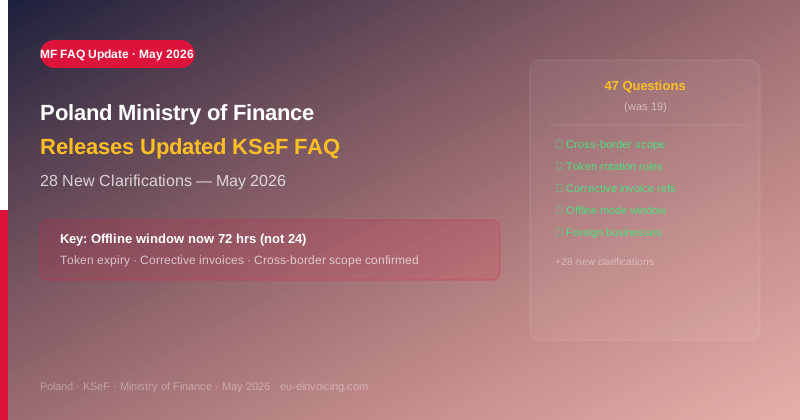
The Polish Ministry of Finance (Ministerstwo Finansów) published an updated KSeF FAQ document on 4 May 2026, expanding from 19 to 47 questions in response to the volume of queries received since the February and April 2026 mandatory rollouts.
Most Significant New Clarifications
1. Cross-Border Scope Confirmation
The FAQ explicitly clarifies that KSeF applies only to domestic Polish B2B invoices — that is, transactions between two Polish VAT-registered entities. Invoices to non-Polish customers are outside KSeF scope, even if issued by a Polish entity.
This resolves a significant area of confusion among Polish exporters who were uncertain whether their invoices to German or Czech customers required KSeF submission.
2. Token Expiry and Rotation Rules
The FAQ provides specific guidance on token management that was absent from the original documentation:
- KSeF authentication tokens have a default validity of 30 days unless configured otherwise
- Token rotation does not invalidate previously issued invoices — the KSeF reference numbers remain valid
- Multiple concurrent tokens can be active, which is recommended for accounting firms managing multiple clients
- If a token expires mid-session, any in-flight invoice submission that was started before expiry will complete; the token must be renewed before the next submission
3. Corrective Invoice (Faktura Korygująca) Rules
A corrective invoice in KSeF must reference the KSeF number of the original invoice — not just the original invoice number. This is different from the pre-KSeF practice of referencing the paper/PDF invoice number.
If the original invoice was issued before the KSeF mandate (pre-February 2026 for large businesses), corrections must still go through KSeF but with a special "pre-KSeF" reference field.
4. Offline Mode Submission Window
The FAQ clarifies that businesses using offline mode (when KSeF is unavailable) have 72 hours (not 24 hours as originally stated in some guidance) to submit offline-created invoices once KSeF is restored. The 72-hour window runs from the end of the offline period.
5. Foreign Businesses with Polish VAT Registrations
Foreign businesses with a Polish VAT number are subject to KSeF for all domestic Polish B2B transactions. The FAQ provides a specific path for foreign businesses using non-Polish ERP systems: they may use a certified Polish intermediary (pośrednik KSeF) to submit invoices on their behalf.
Where to Find the Full FAQ
The complete 47-question FAQ is available (in Polish) at gov.pl/web/finanse/ksef. An unofficial English translation is being maintained by several Polish law firms and accounting bodies.
Source
Ministry of Finance KSeF FAQ, updated 4 May 2026: gov.pl