Spain Verifactu: Mandatory Dates Postponed to 2027 — What Businesses Must Do Now
Spain's Verifactu invoice verification system was originally due to become mandatory in 2026, but Real Decreto-ley 15/2025 pushed the dates back a year: 1 January 2027 for companies, 1 July 2027 for the self-employed. Here is what it requires and why the timeline changed.
Correction notice (6 August 2026): An earlier version of this article stated Verifactu became mandatory on 1 July 2026. That is no longer correct — the Spanish government postponed the mandatory dates by one year in December 2025. This article has been rewritten with the current, verified timeline.
Spain is implementing Verifactu (the VERI*FACTU invoicing-software regulation, formally the Reglamento de los Sistemas Informáticos de Facturación) — an anti-fraud invoice verification system that is separate from, and earlier than, the full B2B e-invoicing mandate under the Ley Crea y Crece (Law to Create and Grow).
The Postponement
The original regulation set Verifactu's mandatory dates at 1 January 2026 (Corporate Income Tax taxpayers) and 1 July 2026 (other businesses and the self-employed). On 2 December 2025, the Spanish government approved Real Decreto-ley 15/2025, published in the BOE on 3 December 2025, which pushed both dates back by exactly one year:
| Taxpayer group | Original deadline | Current deadline |
| Companies (Impuesto sobre Sociedades) | 1 January 2026 | **1 January 2027** |
| Other businesses and self-employed (autónomos) | 1 July 2026 | **1 July 2027** |
The stated reason was to give software vendors and businesses more time for an "orderly and uniform" technical rollout.
What Is Verifactu?
Verifactu is not the same as Italy's SDI or Germany's XRechnung mandate. It is:
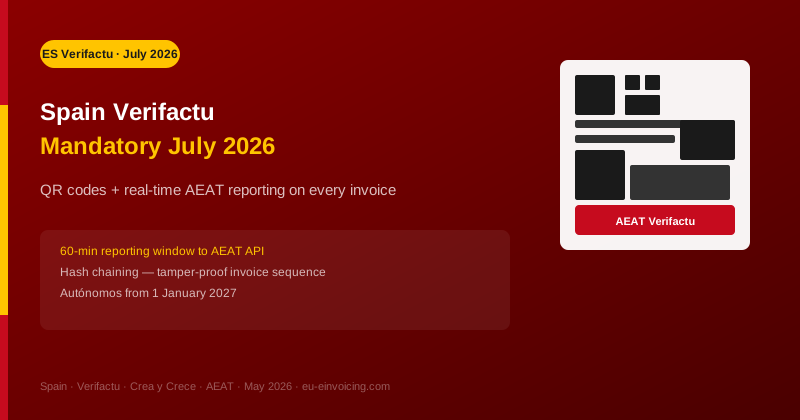
- A requirement for invoicing software to generate a QR code and hash chain on every invoice
- Each invoice must be electronically reported to the Agencia Tributaria (AEAT) in near-real-time
- The invoice itself can still be a PDF — but it must contain the Verifactu hash and QR code
- Designed primarily as a tax fraud prevention measure, not a full structured e-invoice mandate
- Only relevant to businesses using invoicing software — manual invoicing (Word, Excel with no software integration) falls outside its scope
What Your Software Will Need to Support
Once the postponed dates take effect, invoicing software must be certified as VERI*FACTU compliant, meaning it can produce:
- Hash chaining: Each invoice generates a hash that incorporates the previous invoice's hash, creating a tamper-evident chain
- QR code generation: Each invoice contains a QR code linking to the AEAT Verifactu portal for verification
- Real-time submission: Invoice data sent to the AEAT API shortly after issuance
- Immutability: Once an invoice is issued, it cannot be modified (only cancelled with a linked credit note)
This Is NOT the Full B2B E-Invoice Mandate
The full B2B structured e-invoicing mandate under the Crea y Crece law is a separate, later-running track, now given concrete dates by Royal Decree 238/2026: 1 October 2027 for businesses with turnover above €8 million, and 1 October 2028 for everyone else. Verifactu and the B2B mandate will run on overlapping but distinct timelines — see our Royal Decree 238/2026 explainer for the full picture.
What Spanish Businesses Should Do Now
The extra year is a planning window, not a reason to wait. Ask your accounting or invoicing software vendor about their VERI*FACTU certification timeline, since AEAT maintains the authoritative registry of certified software and vendors are expected to roll out compliant versions well ahead of the 2027 deadlines.
Source
Real Decreto-ley 15/2025, of 2 December (BOE, 3 December 2025); Agencia Tributaria Verifactu documentation: agenciatributaria.es.