European Commission Consults on Revising the 2014 eInvoicing Directive
The European Commission ran a public consultation from 18 March to 10 June 2026 on revising Directive 2014/55/EU, the original B2G eInvoicing Directive. Feedback will feed an impact assessment expected to shape a legislative proposal in Q4 2026.
The European Commission has taken the first formal step toward revising Directive 2014/55/EU — the original "eInvoicing Directive" that made structured electronic invoicing mandatory for B2G public procurement across the EU. A public consultation ran from 18 March to 10 June 2026, following an earlier call for evidence that closed in December 2025.
Why the 2014 Directive Needs Revisiting
Directive 2014/55/EU was written for a B2G-only world, before Germany, Italy, France, Poland, and Belgium each built their own domestic B2B mandates on top of (or alongside) the EN 16931 standard it introduced. The result, more than a decade later, is a patchwork: EN 16931 sits underneath XRechnung, ZUGFeRD, Factur-X, and Peppol BIS alike, but national CIUS (Core Invoice Usage Specification) extensions and country-specific submission channels — SDI, KSeF, Chorus Pro/PDP, Peppol four-corner — have grown apart in ways the original directive never anticipated.
The Commission's own framing is that eInvoicing rules need to become "future-proof and fully interoperable," reducing the administrative burden that cross-border businesses currently face when a format valid in one member state isn't automatically accepted in another.
What the Consultation Covered
The questionnaire, run through the Commission's "Have Your Say" portal, sought input from businesses (with particular attention to SMEs), public authorities, eInvoicing service providers, and civil society on:
- Whether the current legal definition of a compliant e-invoice remains fit for purpose
- Interoperability gaps between national CIUS variants of EN 16931
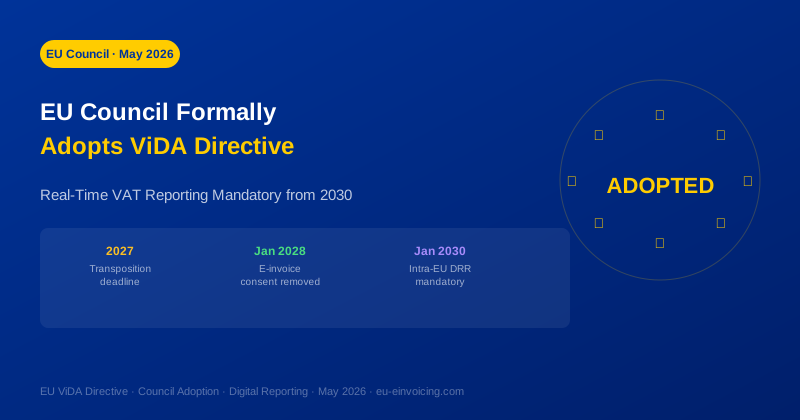
- How the revised directive should align with the VAT in the Digital Age (ViDA) package's 2030 cross-border Digital Reporting Requirements
How This Connects to ViDA
This is a distinct workstream from ViDA, but not an unrelated one. ViDA (adopted March 2025) mandates cross-border digital reporting from 1 July 2030 without itself rewriting the 2014 B2G directive. A revised eInvoicing Directive would be the vehicle for aligning the older B2G legal framework with the B2B reality ViDA is creating — closing the gap between "e-invoicing is required for this specific channel" and "e-invoicing works the same way everywhere."
What Happens Next
Submitted feedback feeds into a Commission impact assessment, with a legislative proposal currently anticipated in Q4 2026. Nothing in the current consultation changes any existing national mandate — Germany's 2027 sending deadline, France's September 2026 phase-in, Poland's KSeF rollout, and Belgium's live Peppol mandate all continue on their own tracks regardless of this review.
What Businesses Should Take From This
There is no action required today. The practical takeaway is that the underlying legal architecture (EN 16931 plus the eInvoicing Directive) is under active review, which is a reason to favor format-agnostic, EN 16931-native software over narrow, single-country tools when choosing or upgrading e-invoicing systems — whatever the directive looks like after revision, EN 16931 compliance is likely to remain the common denominator.
Source
European Commission, Commission launches public consultation on the revision of the eInvoicing Directive, 18 March 2026.