Poland KSeF: Real Lessons from the First 90 Days of Mandatory E-Invoicing
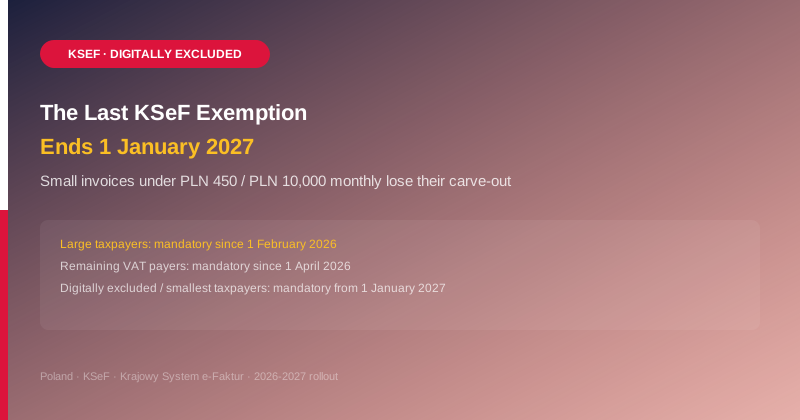
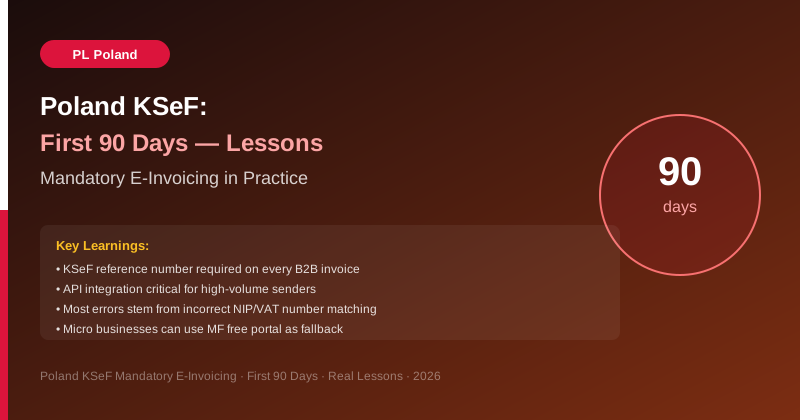
The KSeF mandate went live for large Polish taxpayers on 1 February 2026. Three months in, here are the real-world challenges businesses encountered — and how to avoid them.
Poland's KSeF (Krajowy System e-Faktur) mandate has now been live for over 90 days for large taxpayers. It is a good moment to take stock of how the rollout actually went — beyond the official communications.
What Went Smoothly
Software providers were ready. Unlike the failed July 2024 launch (postponed due to security vulnerabilities in the KSeF infrastructure itself), the February 2026 launch saw most major Polish ERP and accounting software providers ready. Vendors including Comarch ERP, ENOVA365, Insert Nexo, and Sage Symfonia had all received KSeF integration certification before the deadline.
Large taxpayers had prepared. Companies with turnover above PLN 200 million had 18+ months of warning after the July 2024 postponement. Most ran parallel paper and KSeF processes through December 2025, then switched entirely in February.
What Was Harder Than Expected
Token Management
KSeF authentication uses cryptographic tokens tied to a company's NIP (tax ID). Managing these tokens — especially rotating them securely, distributing access across accounting teams, and handling token expiry — turned out to be more operationally complex than most businesses expected.
Several companies reported that their first KSeF rejections weren't format errors — they were authentication failures because a token had expired and nobody had updated it.
Fix: Build token rotation into your internal calendar. Set calendar reminders two weeks before expiry. Assign a specific person responsible for token management.
Offline Mode Procedures
KSeF has occasional maintenance windows (typically Sunday nights, typically brief). During these windows, businesses can still issue invoices — but they must follow a specific offline procedure and submit them within 24 hours of the window closing.
Many companies hadn't drilled their offline procedure before the mandate went live. When the first maintenance window hit in mid-February, a handful of businesses scrambled.
Fix: Test your offline procedure at least once before relying on it. KSeF's test environment supports this.
Multinationals with Polish VAT Registrations
Foreign companies with Polish VAT registrations — but no ERP localised for KSeF — had the toughest time. Sending invoices through head-office ERP systems not integrated with KSeF required either:
1. Building a middleware KSeF connector (complex, 6–12 weeks of development)
2. Using a certified Polish intermediary as a proxy (simpler, but adds routing delays)
Most multinationals chose option 2 for the first months, with option 1 planned for H2 2026.
The April 2026 Extension to All VAT-Registered Businesses
The April 2026 extension — covering all Polish VAT-registered businesses, not just large taxpayers — went more smoothly than many anticipated. Smaller businesses had watched the February rollout, many had already upgraded their software, and the Ministry of Finance ran an extensive awareness campaign.
The main challenge for smaller businesses was understanding that KSeF applies to domestic Polish B2B invoices — cross-border invoices (to/from non-Polish entities) are out of scope for KSeF.
Key Takeaways
- Token management needs a process — this is the most common cause of authentication failures
- Test the offline mode before you need it in a real emergency
- Multinationals need a KSeF strategy early — don't rely on a workaround for more than two quarters
- Cross-border invoices are not in KSeF scope — do not confuse domestic and cross-border workflows
- FA_VAT schema version matters — ensure your software generates FA_VAT 2.0, not FA_VAT 1.0
Useful Resources
- [KSeF documentation (gov.pl)](https://ksef.podatki.gov.pl/)
- [Ministry of Finance KSeF test environment](https://ksef-test.mf.gov.pl)