Romania e-Factura: What EU Businesses Invoicing Romanian Partners Need to Know
Romania's RO e-Factura system has been mandatory for all B2B transactions since July 2024. It is one of the EU's most rigorous real-time systems — and less-known to foreign businesses with Romanian partners. Here is what you need to know.
Romania's RO e-Factura system is one of the EU's most advanced mandatory e-invoicing platforms — yet it receives far less international attention than Germany's XRechnung or Italy's FatturaPA. If your business invoices Romanian companies, or if a Romanian business invoices you, you need to understand this system.
Background
Romania introduced mandatory e-invoicing in stages:
- January 2020: B2G invoicing mandatory via the RO e-Factura platform (e-factura.ro)
- November 2023: B2B mandatory for large taxpayers (turnover > RON 5 million / ~€1M)
- January 2024: B2B mandatory for all high-risk sectors (construction, hospitality, wholesale)
- July 2024: B2B mandatory for all VAT-registered businesses in Romania
As of July 2024, every domestic Romanian B2B invoice must go through RO e-Factura. The platform is operated by ANAF (Agenția Națională de Administrare Fiscală), Romania's national tax authority.
How RO e-Factura Works
The RO e-Factura system is a real-time clearing house — similar to Italy's SDI but with even shorter processing windows:
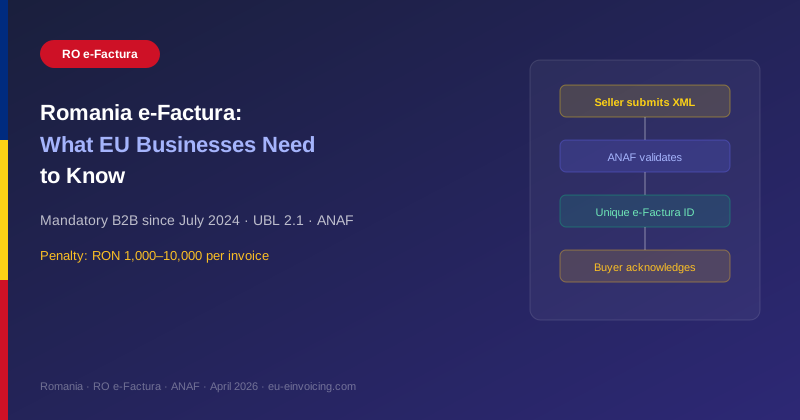
- The seller submits an XML invoice (in UBL 2.1 format) to e-factura.ro via API or web interface
- ANAF validates the XML against schema and business rules
- If valid, ANAF assigns a unique e-Factura ID (the Romanian equivalent of Italy's SDI progressive number)
- The validated invoice is transmitted to the buyer's ANAF account
- The buyer must acknowledge or dispute the invoice within 5 working days
Key difference from Italy's SDI: Romania requires the buyer to actively acknowledge receipt. An unacknowledged invoice is not legally settled as received.
What Foreign Businesses Must Do
If You Have a Romanian VAT Registration
Foreign businesses with a Romanian VAT number are fully subject to RO e-Factura for all domestic Romanian B2B transactions. This includes:
- Companies with Romanian subsidiaries or branches
- Foreign companies VAT-registered in Romania under the reverse charge mechanism
- Non-resident companies that have opted for voluntary Romanian VAT registration
You must either:
- Integrate your ERP/accounting system with the RO e-Factura API, or
- Use a certified Romanian fiscal intermediary to submit invoices on your behalf
Most international ERP vendors (SAP, Oracle, Microsoft Dynamics) have added Romanian e-Factura modules. Verify your version is updated.
If You Invoice Romanian Businesses But Are Not VAT-Registered in Romania
If you are an EU business invoicing a Romanian customer under the EU reverse charge rules (no Romanian VAT registration), RO e-Factura does not apply to your side of the transaction. Your Romanian customer may need to self-report, but you issue the invoice in your own country's format.
The Format: UBL 2.1 (Not FatturaPA or XRechnung)
RO e-Factura uses UBL 2.1 XML — the same underlying standard as Peppol BIS 3.0. However, Romania uses a specific national profile with additional ANAF-required fields. A standard Peppol BIS 3.0 invoice will NOT pass RO e-Factura validation without localisation.
Penalties
ANAF applies penalties of RON 1,000–10,000 per non-compliant invoice for businesses that fail to route through RO e-Factura. Since the July 2024 full mandate, Romanian tax inspectors have been actively auditing B2B invoice flows.
Practical Steps for EU Businesses
- Check if you are VAT-registered in Romania — if yes, you are in scope
- Contact your ERP/accounting software vendor about their Romanian e-Factura support
- If you use a Romanian accountant or fiscal representative, verify they handle e-Factura submission
- Test your submission on the ANAF test environment: [efactura.mfinante.gov.ro](https://efactura.mfinante.gov.ro)
Source
Official RO e-Factura documentation: mfinante.gov.ro