Bulgaria Rolls Out Mandatory SAF-T Reporting in Five Phases Through 2030
Bulgaria's National Revenue Agency began phasing in mandatory SAF-T (Standard Audit File for Tax) reporting from 1 January 2026, starting with roughly 460 large taxpayers. The obligation cascades down by company size each year until it covers every VAT-registered business, including micro-enterprises, by 2030.
While most EU e-invoicing coverage focuses on clearance mandates like Italy's SDI or Poland's KSeF, Bulgaria has taken a different route: a phased SAF-T (Standard Audit File for Tax) reporting requirement rather than a real-time invoice clearance system — though it points in the same direction of tighter, structured tax data reporting.
What SAF-T Requires
Unlike an invoice clearance model, SAF-T does not intercept invoices before they reach the customer. Instead, in-scope businesses must submit structured monthly (and annual) accounting data files to Bulgaria's National Revenue Agency (NRA), covering transactions, accounting entries, and — in the annual file — fixed assets and inventory.
The Five-Phase Timeline
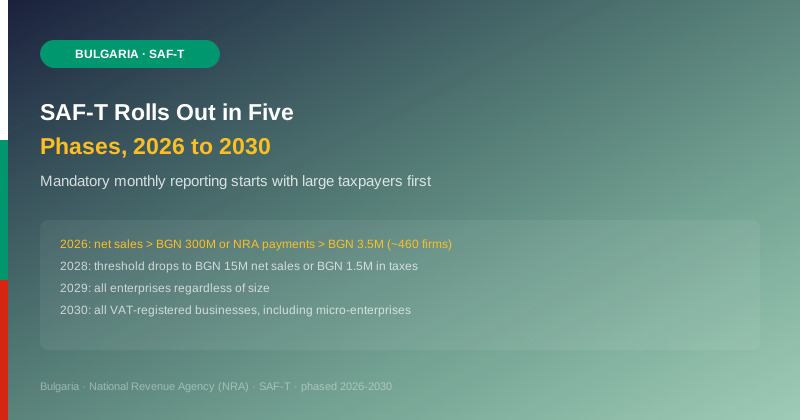
- 1 January 2026: Large taxpayers registered with the NRA's Large Taxpayers & Insurers directorate — net sales revenue for 2023 above BGN 300 million (~€153M), or tax and social-security payments above BGN 3.5 million (~€1.8M). Roughly 460 companies fall into this first wave.
- 2027: The next tier of large taxpayers, assessed against 2024 financial data.
- 1 January 2028: The threshold drops sharply — businesses with net sales above BGN 15 million (~€7.7M) or tax/social-security payments above BGN 1.5 million (~€770K) join the requirement, bringing in most medium-sized companies.
- 1 January 2029: All enterprises, regardless of size, become subject to SAF-T.
- 1 January 2030: The requirement extends to all VAT-registered businesses, including micro-enterprises, closing out the rollout.
Filing Mechanics
The first monthly SAF-T file was due 14 February 2026, and each in-scope business must file monthly going forward, with the first annual file for 2026 due by 30 June 2027. Each phase also carries a six-month grace period during which the NRA will not penalize filing errors, giving businesses time to correct their initial submissions.
What This Means If You Trade With Bulgarian Businesses
SAF-T is a reporting obligation on the Bulgarian business itself, not a format your invoices need to match — Bulgarian B2B and B2C e-invoicing remain voluntary for now, and B2G invoicing stays receive-only under EN 16931 rules dating to 2019. If you invoice large Bulgarian counterparties, expect them to ask more detailed questions about transaction-level data on your invoices as they prepare their SAF-T files, even though no format change is required on your end yet.
Source
Sovos, "Bulgaria: Mandatory SAF-T reporting from 2026"; PwC, "Bulgaria - Corporate - Significant developments".