Portugal Delays Qualified Signature Requirement for PDF Invoices to 2027 — Again
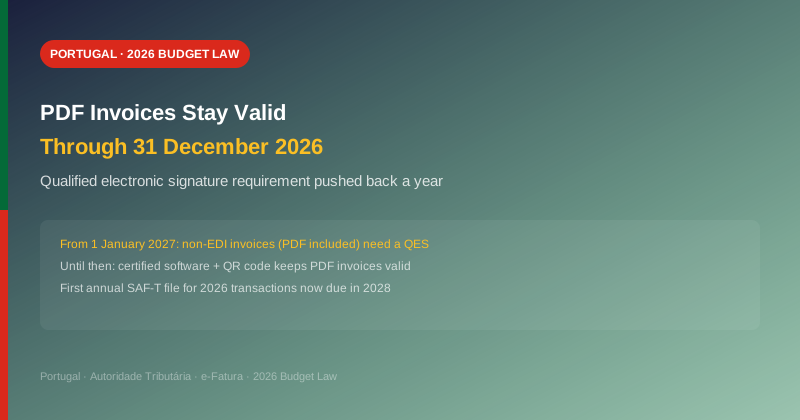
Portugal's 2026 Budget Law extended the validity of PDF invoices without a qualified electronic signature (QES) through 31 December 2026 — the latest in a series of postponements — while also pushing the first mandatory annual SAF-T accounting file back to 2028.
Portugal has repeatedly delayed a rule that would have forced businesses off simple PDF invoices and onto qualified electronic signatures. The 2026 Budget Law extends that delay once more, and adds a separate delay to SAF-T accounting-file reporting.
The PDF Invoice Rule
Under Portuguese tax law, a PDF invoice is treated as equivalent to a paper invoice — and therefore valid for tax purposes — provided it is issued by AT-certified invoicing software and carries the required ATCUD QR code. The separate, stricter requirement — that non-EDI invoices (PDFs included) carry a full Qualified Electronic Signature (QES) — has been pushed back multiple times since it was first legislated.
What Changed
The 2026 Budget Law extends the PDF-without-QES tolerance through 31 December 2026. From 1 January 2027, non-EDI invoices, including PDFs, will need a QES to remain valid for tax purposes under current law — unless the government delays it again, which is exactly what has happened in each of the last few budget cycles.
The SAF-T Change
The same budget law also delays SAF-T accounting-file obligations: the first mandatory annual SAF-T file covering 2026 transactions is now due in 2028, rather than the previously scheduled date. This gives businesses — the government specifically cited smaller companies — more time to adapt their software before both requirements land at once.
Why the Repeated Delays
The Portuguese government has cited the administrative and technical burden of QES adoption for smaller businesses as the reason for each postponement. For a business used to certified software and a QR code, a full digital-certificate-based signature workflow is a meaningfully bigger technical lift, and Portugal's tax authority has consistently prioritized giving SMEs time over enforcing the original schedule.
What Portuguese Businesses Should Do Now
- Nothing changes today — PDF invoices issued through AT-certified software with a valid ATCUD QR code remain fully valid through the end of 2026.
- Don't assume the 2027 QES date is soft — it has moved before, but budget-law extensions are not guaranteed, and building QES capability now avoids a rushed migration if this is the year it actually takes effect.
- Track the SAF-T change separately — the annual file delay to 2028 does not affect the PDF/QES timeline, and confusing the two deadlines is a common mistake in compliance write-ups.
Source
Marosa, "New Postponement of Qualified Digital Signature Requirement for Invoices in Portugal"; Fiscal Solutions, "Portugal delays mandatory qualified electronic signatures for e-invoices to 2026".