Denmark Proposes "E-Invoicing by Default" Without a Full B2B Mandate
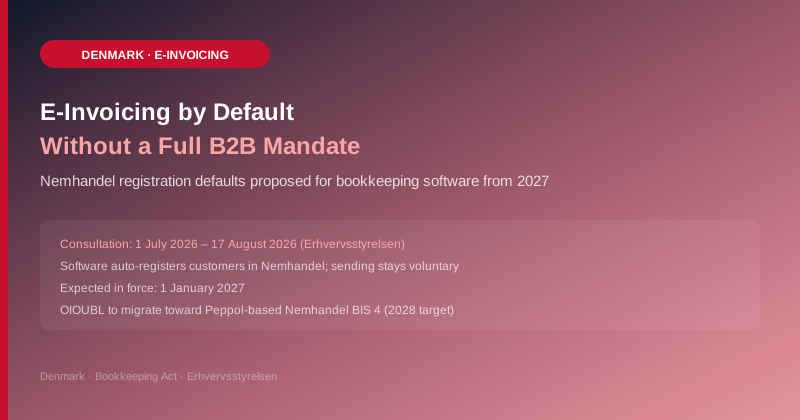
The Danish Business Authority consulted from July to August 2026 on a rule that would make bookkeeping software register business customers for e-invoicing in the Nemhandel registry by default and present it as the first sending option — stopping short of a compulsory B2B mandate.
While France, Belgium, and Poland have gone the route of a hard B2B e-invoicing mandate, Denmark is testing a softer mechanism: making structured e-invoicing the path of least resistance rather than a legal requirement.
What the Danish Business Authority Proposed
The Erhvervsstyrelsen (Danish Business Authority) published a draft amendment to the executive order governing digital standard bookkeeping systems for public consultation on 1 July 2026, closing on 17 August 2026. Under the draft, providers of registered digital bookkeeping systems — the software category already required under Denmark's 2022 Bookkeeping Act (Bogføringsloven) — would have to:
- Automatically register their business customers in the Nemhandel e-invoicing registry, unless the business actively opts out
- Check whether an invoice recipient is registered in Nemhandel before sending, and if so, present structured e-invoicing as the default, first-listed sending option in the software's interface
- Meet added security requirements, including identity verification and tighter controls on amending registered company data
Crucially, actually sending the invoice as a structured e-invoice would remain voluntary — the software nudges the default choice, but nothing in the draft compels a business to use it. This is a deliberate alternative to a French- or Belgian-style mandate: Denmark already requires businesses to be capable of digital bookkeeping and e-invoicing under the Bookkeeping Act (phased in through 2026), and this amendment pushes adoption up through defaults rather than a legal sending obligation.
Timeline
The amended executive order is expected to take effect on 1 January 2027, pending the outcome of the consultation. Separately, and on a longer timeline, Denmark is preparing to migrate its 20-year-old OIOUBL e-invoice format to a new Peppol-aligned standard, referred to as Nemhandel BIS 4, with a release candidate targeted for 2028 — a multi-year format transition, not a 2026-2027 event.
Why This Is Worth Watching Beyond Denmark
Denmark's "default, not mandatory" approach is a live test case for a lighter-touch path to e-invoicing adoption, relevant to businesses trading with Danish counterparties and to policymakers elsewhere weighing whether opt-out defaults can lift structured-invoice usage without the compliance and enforcement overhead of a full mandate.
What Businesses Trading With Denmark Should Do Now
- If you use a Danish-registered digital bookkeeping system, expect it to start defaulting to Nemhandel e-invoicing for registered recipients from around January 2027 — check with your vendor rather than assuming no change is coming.
- Don't confuse this with a mandate — sending a structured invoice will still be optional under this draft; only the software's default behavior changes.
- Track the OIOUBL-to-Peppol BIS 4 migration separately — it runs on its own, longer timeline and is not tied to the January 2027 default-registration rule.
Source
VATupdate, "Denmark proposes 'e-invoicing by default' without imposing a B2B mandate"; VATupdate, "Denmark consults on default Nemhandel registration in bookkeeping software".