France Confirms No Postponement: DGFiP Publishes Practical Guide Days Before 1 September Launch
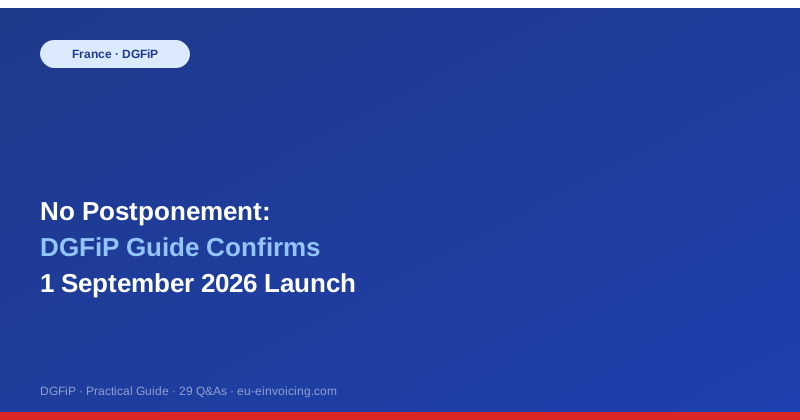
With France's e-invoicing reform going live on 1 September 2026, the DGFiP has published a practical startup guide answering 29 common questions and confirmed it will not automatically sanction good-faith businesses that hit technical difficulties in the early weeks.
As France's B2B e-invoicing reform reaches its 1 September 2026 start date, the Direction Générale des Finances Publiques (DGFiP) has moved to settle lingering uncertainty with two announcements: the reform will not be delayed, and it will not automatically penalize businesses acting in good faith.
The Practical Guide
On 10 July 2026, the DGFiP published a guide pratique de démarrage (practical startup guide) on impots.gouv.fr, structured as 29 questions and answers covering the situations businesses were most worried about — what happens if a supplier can't yet issue a structured invoice, how to handle a platform outage, and how existing PDF or paper invoicing fits into the transition.
What's Confirmed for 1 September 2026
- The obligation to receive e-invoices via an approved platform (PDP) is generalized to all VAT-registered businesses in France from 1 September 2026
- The obligation to issue structured e-invoices and e-report transaction data applies from the same date to large enterprises and mid-sized companies (ETI)
- TPEs and SMEs (small and micro businesses) follow on 1 September 2027, unchanged from the existing timeline
No Automatic Sanctions During Startup
The DGFiP's guide sets out a "tolerance" policy: businesses that act in good faith and can demonstrate genuine effort to comply won't face automatic penalties for teething problems in the first weeks. This is not a delay or suspension — the legal deadlines are unchanged — but a statement that enforcement will weigh good faith and proportionality rather than issuing fines the moment a technical hiccup occurs. If a platform-side incident interrupts normal exchange, the guide confirms businesses can fall back to PDF or paper invoicing temporarily, provided the underlying transaction is real and the invoice carries the required information, and regularize the exchange through an approved platform once resolved.
Support Channel
The DGFiP has also opened a dedicated business assistance line — 0806 807 807, Monday to Friday, 8:30am–6pm — for questions on the transition.
What Businesses Should Do Now
If you're a large or mid-sized business in France, confirm your PDP (Plateforme de Dématérialisation Partenaire) — Pennylane, Cegid, Sellsy, Axonaut, and others serving the French market are among those certified — has completed onboarding and that your invoice generation has been tested end-to-end before 1 September. The tolerance policy is a safety net for good-faith effort, not a reason to delay preparation.
Source
DGFiP, Facturation électronique : guide pratique de démarrage.