France's E-Invoicing Mandate: The First Week, By the Numbers
In the week following France's 1 September 2026 e-invoicing go-live, the Portail Public de Facturation logged over 2.5 million invoice flows — but daily rejection rates climbed sharply as new issuers came online, and fewer than half of large companies had issued their first structured e-invoice.
France's B2B e-invoicing and e-reporting reform stopped being a countdown and became a live system on 1 September 2026. A week later, the first operational numbers are in — and they show a rollout that is working, but not without friction.
The First-Week Numbers
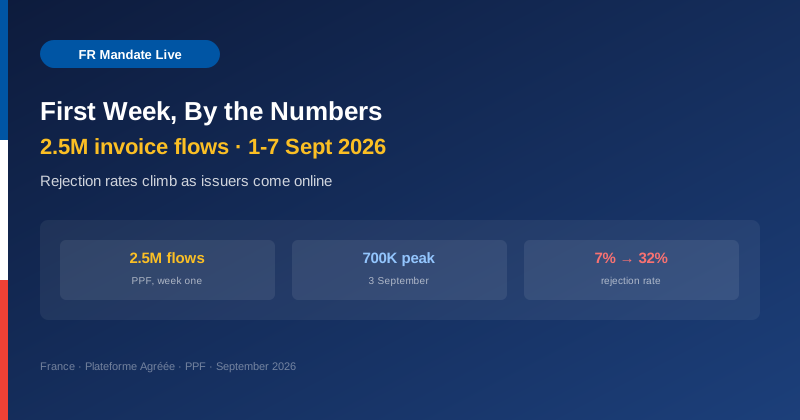
Between 1 and 7 September 2026, the Portail Public de Facturation (PPF) — the government's central data-concentrator — recorded more than 2.5 million invoice flows, with a single-day peak of roughly 700,000 flows on 3 September, according to tracking published by comparatif-facture-electronique.fr.
Uptake was uneven. Fewer than half of large enterprises ("GE") had issued their first structured e-invoice through an accredited Plateforme Agréée (PA) in that first week, even though issuance became mandatory for large and mid-sized companies (ETI) from day one.
Rejection Rates Climbed as Volume Grew
The trend that drew the most attention was on data quality, not volume. Comparatif-facture-electronique.fr tracked the daily rejection rate rising from roughly 7% to over 30% over the course of the week, as more issuers moved into production and exposed gaps in their invoice data. Separately, French fintech publication mind.eu.com reported that 23% of "F1" invoice flows were rejected on the very first day, 1 September.
Both trackers point to similar root causes: invoices failing validation because the structured format wasn't respected, or because a mandatory field — most often the buyer's SIREN/legal identifier or a VAT line item — was missing.
The Government's Response
On 3 September, the Agence pour l'informatique financière de l'État (AIFE) and the Direction Générale des Finances Publiques (DGFiP) convened more than 400 representatives of accredited PAs for an emergency debrief on the reform's opening days — a sign the administration is actively monitoring the rollout rather than treating 1 September as a fixed finish line.
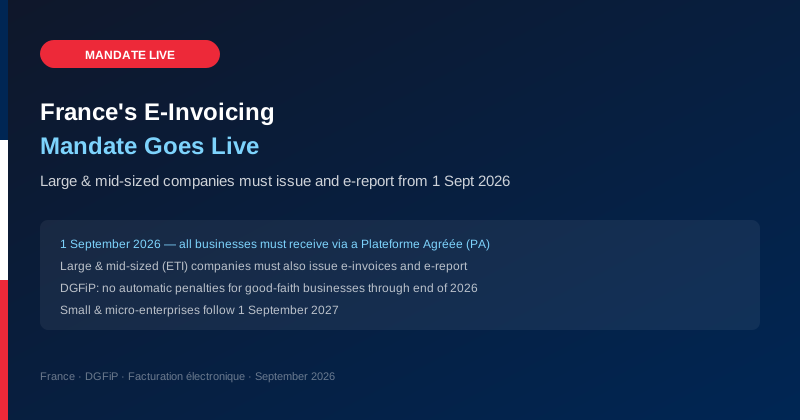
This lines up with the tolerance policy the DGFiP had already announced before launch: no automatic penalties for good-faith businesses hitting technical difficulties through the end of 2026 (see our earlier coverage of France's mandate going live).
What This Means If You Trade With French Businesses
- A rejected invoice in week one is not unusual — it does not necessarily mean your own integration is broken, but it is worth checking the specific rejection reason your PA returns rather than assuming a one-off glitch.
- Fewer than half of large companies issuing invoices in week one means many of your French counterparties may still be catching up — don't assume a supplier is non-compliant just because you haven't received a structured invoice from them yet.
- Expect the rejection rate to keep moving as more mid-sized and eventually small businesses join the system through 2027; treat this as a multi-quarter transition, not a one-week event.
Source
Comparatif e-Facturation, "Facturation électronique : les premiers chiffres du démarrage"; mind.eu.com, "Facturation électronique : 23% des flux F1 rejetés dès le premier jour".