Slovakia Declares eFaktúra Infrastructure Complete and Fully Functional Ahead of 2027 Mandate
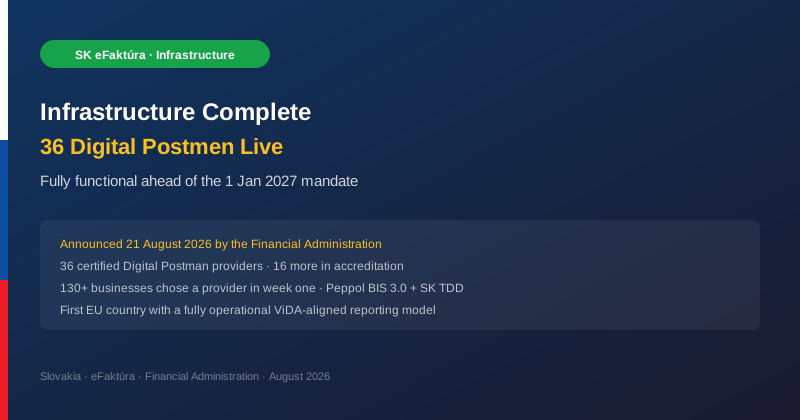
Slovakia's Financial Administration announced on 21 August 2026 that the communication infrastructure behind its eFaktúra system is complete and fully functional, with 36 certified 'Digital Postman' providers live and 16 more in accreditation — positioning Slovakia as the first EU country with a fully operational ViDA-aligned reporting model ahead of its 1 January 2027 mandate.
Slovakia's Finančná správa (Financial Administration) announced on 21 August 2026 that the communication infrastructure underpinning its eFaktúra (IS EFA) system is now complete and fully functional — a significant readiness milestone roughly four months before the system becomes mandatory.
What "Complete" Means Technically
The announcement confirms that the infrastructure enables automated transmission of tax data extracted directly from eFaktúras, without businesses needing to separately rewrite or resubmit that data for VAT reporting purposes. Slovakia's model routes invoices through Peppol BIS Billing 3.0 for the invoice exchange itself, alongside the national SK TDD (Slovak Tax Data Document) format for the parallel tax-reporting layer — combining structured invoicing and near-real-time reporting to the tax authority in a single flow, an approach the Financial Administration describes as the first fully implemented electronic reporting model of its kind aligned with the EU's ViDA framework.
The Digital Postman Network
Slovakia's exchange model doesn't run through a single central government gateway (unlike Italy's SDI). Instead, invoices move through accredited "Digital Postman" (Digitálny Poštár) intermediaries — certified private delivery-service providers that businesses choose and register with. As of the announcement:
- 36 certified Digital Postman providers are live
- 16 more providers are in the accreditation pipeline
- More than 130 business entities selected a Digital Postman in the first week the selection directory opened
The Financial Administration has framed the multi-provider design as a resilience feature: an outage or security incident affecting one Digital Postman does not halt e-invoicing nationwide, since businesses are distributed across a network of independently certified providers rather than a single chokepoint.
Why the Timing Matters
Slovakia's mandatory eFaktúra rollout for domestic B2B and B2G transactions begins 1 January 2027, with a voluntary transition period running since the start of 2026 to let businesses and software vendors test the system. Confirming the infrastructure is complete — rather than still being built — roughly four months before the hard deadline gives businesses a firmer basis for finalizing their own integration timelines, and follows a series of free regional conferences the Financial Administration ran through September 2026 to walk businesses through practical implementation.
What Businesses Trading in Slovakia Should Do
- Select a Digital Postman now if you haven't already — with 36 accredited providers live, comparing pricing and integration support ahead of the January 2027 deadline is more useful than waiting.
- Confirm your accounting or ERP software's Digital Postman routing is tested end-to-end, not just generically "Peppol-compatible" — Slovakia's SK TDD reporting layer is specific to this system.
- Don't wait for the mandatory date to test. The voluntary transition period and now-complete infrastructure mean the system is available to trial well before it becomes compulsory.
Source
FinReport.sk, Finančná správa: Infraštruktúra pre systém elektronickej fakturácie je kompletná a plne funkčná, 21 August 2026.